

VertLab · inside CourtVision
Watch the rimget closer.
The vertical jump lab in your pocket. Test your jump, see exactly how far you are from the rim and your first dunk, and follow a real program to close the gap.

Scan to get it on your iPhone
Your first form check is free. Pro unlocks everything after that.
On Android? CourtVision is iPhone only right now. Android is coming.
Join the Android listStep 1 · Test
Know yournumber.
Three ways to test, and every result is labeled with how it was measured so you're never comparing apples to oranges.
Wall reach test
Mark your standing reach, jump and touch, measure the gap. The most reliable test you can do at home.
Phone sensor Beta
Hold the phone to your chest and jump. It times your flight, the same method contact mats use.
From your gym
Got a number from a Vertec or a coach? Log it and track from there.
Test standing and approach jumps separately. Retest every 4 weeks, fresh, with the same method.

Step 2 · See the gap
Inches, notguesses.
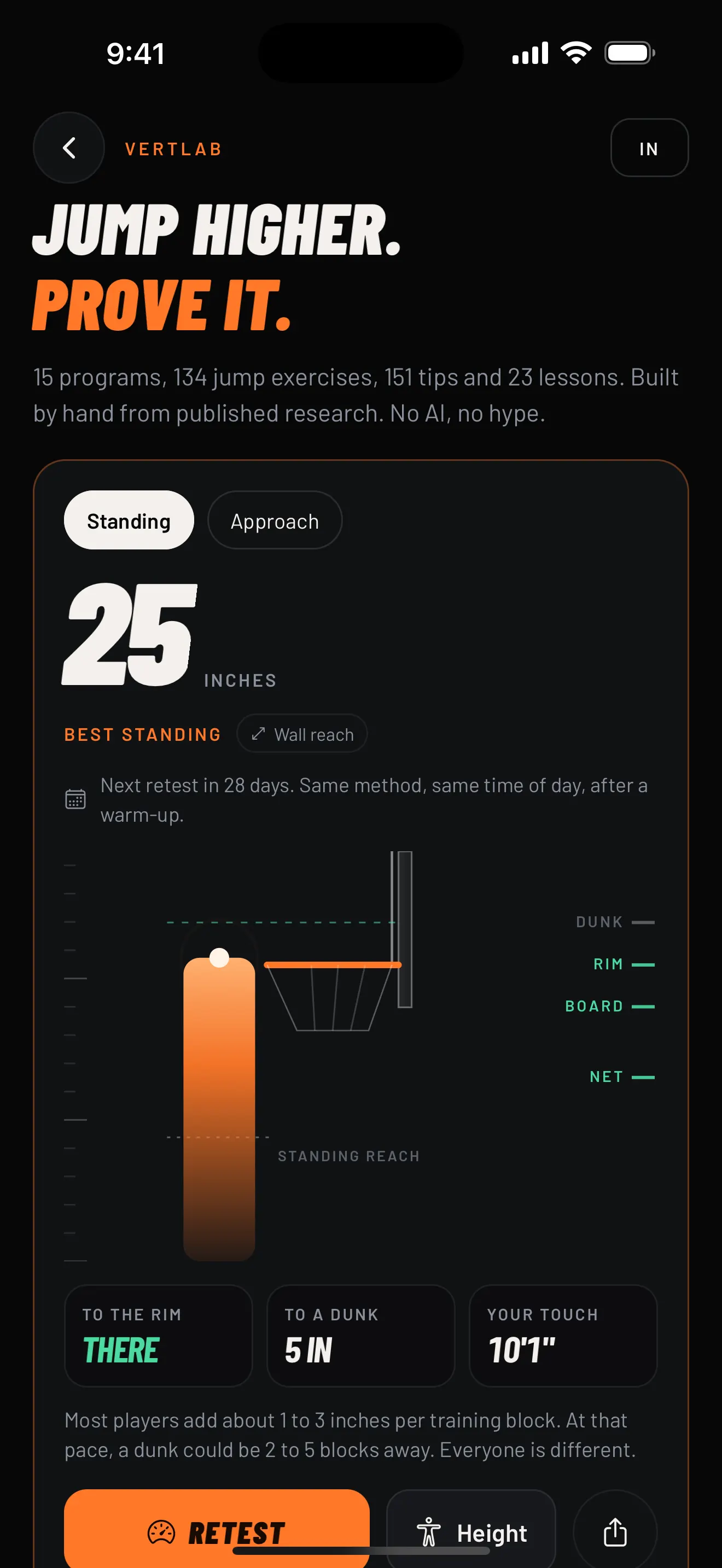
The rim meter turns your height, reach and jump into the only numbers that matter: how far you are from touching the rim, grabbing it and dunking.
- Touch the net8'8" touch
- Touch the backboard9'6" touch
- Touch the rim10'0" touch
- Grab the rim10'3" touch
- Dunk a tennis ball10'4" touch
- Dunk a volleyball10'5" touch
- Dunk a basketball10'6" touch
- Two-hand dunk10'9" touch
Step 3 · Train
15 jumpprograms.
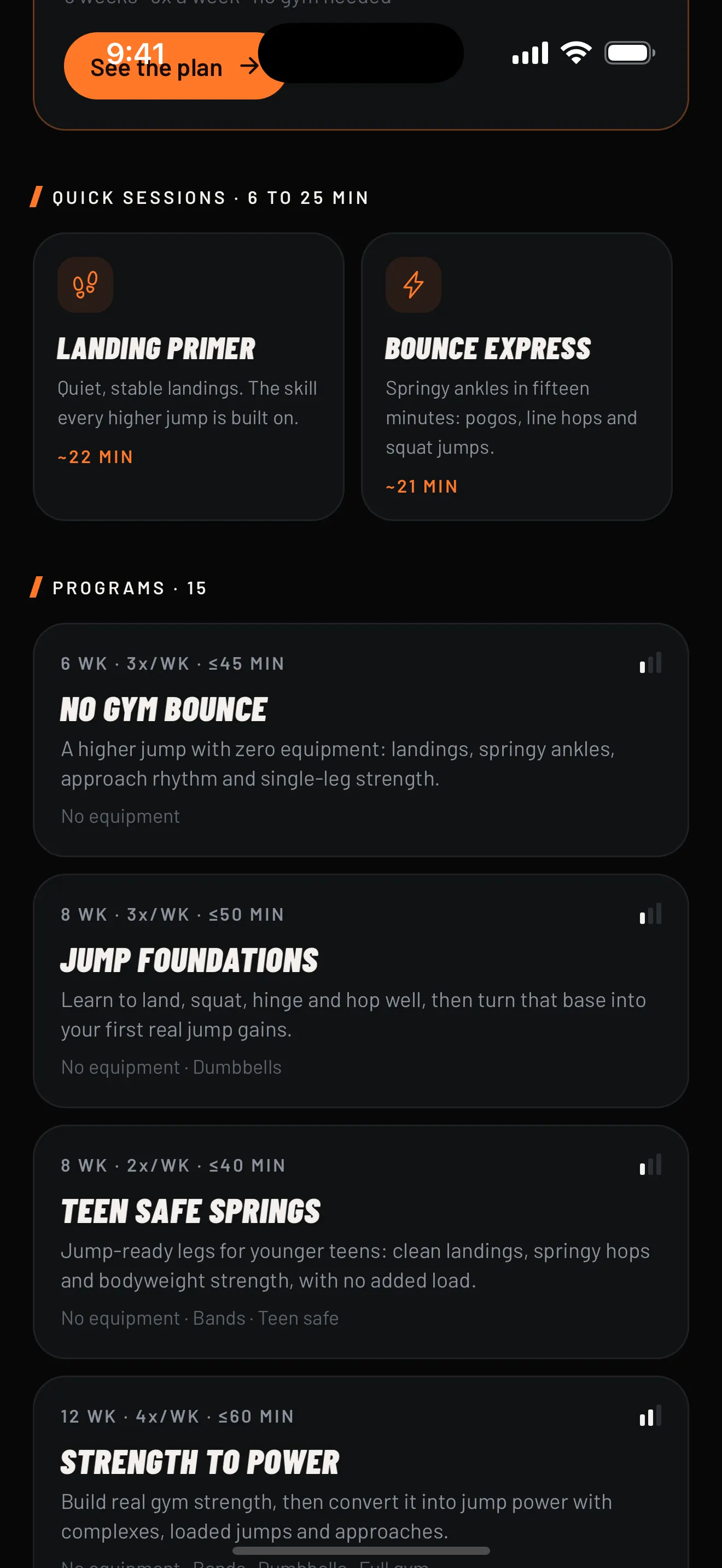
From a two-week kickstart to a 16-week Dunk Quest. Each one tells you who it's for, what gear it needs and how long a session takes.
Beginner
No Gym Bounce45 min · Bodyweight
A higher jump with zero equipment: landings, springy ankles, approach rhythm and single-leg strength.
Who it's for: Any hooper training at a park, driveway or school gym with no weights. New to jump training is fine.
Jump Foundations50 min · Bodyweight, Dumbbells
Learn to land, squat, hinge and hop well, then turn that base into your first real jump gains.
Who it's for: Beginners and anyone returning to training. A pair of dumbbells helps; no barbell needed.
Teen Safe Springs40 min · Bodyweight, Bands
Jump-ready legs for younger teens: clean landings, springy hops and bodyweight strength, with no added load.
Who it's for: Players about 13 to 15, or anyone new to training, ideally with a coach or parent watching.
Tendon & Ankle Bulletproof40 min · Bodyweight, Bands
Tougher calves, Achilles, knees and ankles: isometric holds, slow lowering and low hops.
Who it's for: Anyone who jumps a lot, has had rolled ankles or achy knees (and is cleared to train). Pairs with any program.
Two-Week Kickstart35 min · Bodyweight
A short, no-equipment start: learn to land, warm up properly and test your first jump.
Who it's for: Brand-new users who want to try VertLab before picking a longer program.
Four-Week Jump Reset40 min · Bodyweight, Bands
Ease back into jumping after time off: tendon holds, landings and low hops that ramp up gently.
Who it's for: Anyone returning from a break, or from a pain flare-up once a professional has cleared them to train.
Adult Hooper Spring50 min · Bodyweight, Bands, Dumbbells
Springier legs for rec-league and pickup players: longer warm-ups, tendon work and smart jumps.
Who it's for: Adult hoopers, often 30 and up, who want to jump better and feel better after games.
Intermediate
Strength to Power60 min · Bodyweight, Bands, Dumbbells, Gym
Build real gym strength, then convert it into jump power with complexes, loaded jumps and approaches.
Who it's for: Intermediate lifters with gym access who already land well and squat with good form.
Dunk Quest60 min · Bodyweight, Bands, Dumbbells, Gym
A 16-week path from base strength to approach jumps to dunk attempts, with honest checkpoints along the way.
Who it's for: Intermediate players with gym access who can already touch the net or backboard and want the rim and beyond.
Approach Jump Mastery35 min · Bodyweight
Turn run-up speed into height: penultimate step, arm swing, plant and one-foot takeoffs.
Who it's for: Anyone who already lands well and wants a higher approach jump. Runs alongside a strength program.
In-Season Bounce30 min · Bodyweight, Dumbbells
Keep the bounce you built during the season with two short, low-volume, high-intent sessions.
Who it's for: Anyone playing games every week. Short sessions, low soreness, repeat the block all season.
Dumbbell Vert55 min · Bodyweight, Dumbbells
Everything a jumper needs from one pair of dumbbells: squats, hinges, single-leg work and loaded jumps.
Who it's for: Intermediate players training at home or in a small gym with dumbbells and a bench or step.
Single-Leg Takeoff50 min · Bodyweight, Dumbbells
More pop off one foot: knee drive, single-leg strength, skips and one-foot approaches.
Who it's for: Slashers and guards who finish off one foot. Intermediate players with a few dumbbells.
Advanced
Off-Season Max Power60 min · Bodyweight, Bands, Dumbbells, Gym
A full off-season block for experienced jumpers: heavy strength, contrast pairs, depth jumps and a peak.
Who it's for: Advanced, healthy athletes with a solid squat, clean landings and at least a year of jump training.
Reactive Springs (RSI)40 min · Bodyweight, Gym
Spend less time on the floor: short-contact hops, drop jumps and bounds to raise your reactive strength.
Who it's for: Advanced jumpers with strong calves and clean landings who feel slow off the floor.
Knees first
Built to keep you jumping
- A knee check before every jump day.
- Landing work comes before anything explosive.
- At least 48 hours between jump sessions, and practice counts as jumping.
- Pain above 3 out of 10 swaps you to an easier day. Sharp pain means stop and see a physio or doctor.
Honest results
No 10-inch promises
Most players add about 1 to 3 inches over 6 to 12 weeks of steady training. That's what the research says, and that's what we tell you. Bigger jumps happen, especially for players new to strength work, but nobody can promise them.
Built from published research on plyometrics and strength training. Not medical advice.
Questions
Jumpquestions.
How much can I add to my vertical?
How do I test my vertical at home?
Do I need a gym?
Is jump training safe for teens?
How often should I train?
The rim'snot moving.
Train today. Watch the rim get closer. Your first form check is free.
Scan to get it on your iPhone
Your first form check is free. Pro unlocks everything after that.
On Android? CourtVision is iPhone only right now. Android is coming.
Join the Android list